Highlights from our CPO Summit: Deep Dive into Family-Friendly Leadership & Culture
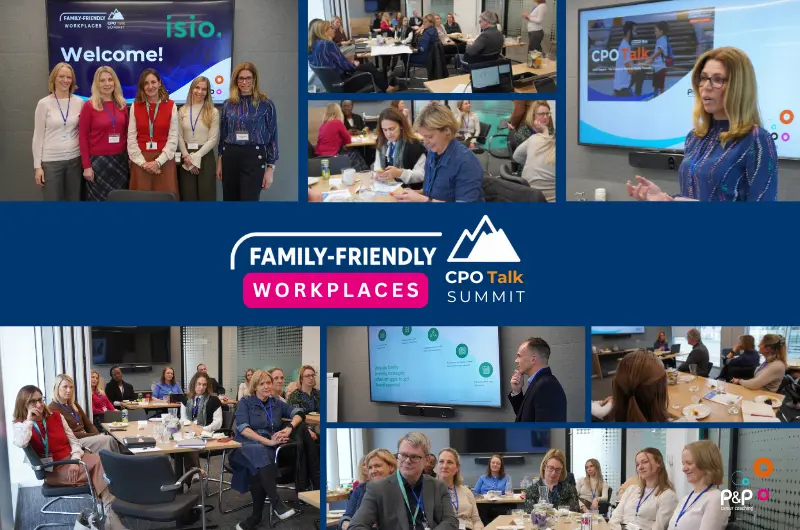
Hosted in partnership with Isio, our recent CPO Summit brought together People leaders from across industries to explore what “family-friendly” really means in a results-driven world.
This wasn’t a conference of soundbites or surface-level optimism. It was a room of experienced leaders ready to speak candidly about pressure, trade-offs, and what’s genuinely working inside their organisations.
The conversations were thoughtful, challenging, and — above all — grounded in reality.
What we heard from CPOs
1. Leadership must set the tone — visibly and consistently
Culture doesn’t sit in policies or programmes alone. It lives in the behaviour, boundaries and decisions of senior leaders.
CPOs spoke openly about the importance of leadership teams being clear on:
- What they stand for
- Where flexibility has limits
- How values show up when the pressure is on
- How to turn lived experience into purposeful leadership — using personal stories as fuel for organisational change
- How to embed real accountability — with clear objectives that hold both leaders and teams to measurable outcomes
Without this clarity, even the best-designed initiatives struggle to land.
2. DE&I is under pressure — and needs leadership backing more than ever
Despite the challenges that the current geopolitical landscape is throwing our way, there was strong consensus that DE&I hasn’t disappeared — but it has changed.
With tighter budgets and heightened scrutiny, People teams are being asked to:
- Create cultural conditions for success
- Demonstrate impact
- Show return on investment
- Connect inclusion work directly to retention, performance and engagement
What made the difference?
Visible leadership sponsorship — and the confidence to articulate why this work matters, even when resources are constrained.
3. Transitions are no longer “nice-to-have” conversations
Parental leave. Caring responsibilities. Health changes. Career pivots.
What used to be treated as individual or one-off issues are now being recognised as strategic moments that shape retention and loyalty.
The room shared powerful reflections on how:
- Poorly supported transitions drive attrition
- Well-supported transitions build trust and long-term commitment
- Managers need far more support than we often acknowledge
This is where culture, capability and business outcomes truly intersect.
Launching the 2026 Report: The Future of Work is Family-Friendly
The Summit also marked the launch of our new report: The Future of Work is Family-Friendly
Drawing on insights from Chief People Officers across our podcast series and events, the report brings together:
- Real-world leadership insight
- Practical examples from organisations navigating complexity
- A clear business case for investing in family-friendly cultures — even in challenging times
Helen Letchfield, Co-Founder P&P, shared 5 key insights from the report
- Leadership sets the tone – Culture is built through leadership behaviour, not just policy. It starts with what leaders stand for, and how visibly they live those values.
- Transitions matter – Parental leave, caring responsibilities, and health shifts are no longer “side conversations.” They’re strategic moments that directly impact retention.
- Flexibility needs boundaries – The goal isn’t unlimited freedom, but clarity. Clear frameworks help both organisations and employees navigate flexibility sustainably.
- Inclusion needs ROI – DE&I efforts must go beyond good intentions. They need to demonstrate measurable outcomes and contribute to business performance.
- Wellbeing must evolve – Emotional, physical and psychological support isn’t optional. It’s a commercial lever that directly affects productivity, loyalty and culture.
Download the 2026 Report: The Future of Work is Family-Friendly
We also heard from Mark Jones, Partner at Isio, and member of their Inclusion & Belonging SteerCo
Mark challenged us to rethink how we position inclusion and wellbeing as hard-edged business priorities — not soft perks.
“Probably all of us in this room believe this isn’t just about being nice to the workforce. It’s a clear commercial decision. If you invest money today, you will get a financial return.”
He made it clear that while HR and People teams often see the value instinctively, many CFOs still don’t — not because they don’t care, but because they’ve been trained to look at cost first.
His call to action? Translate your people strategy into numbers CFOs can work with. Show the numbers. Make the case. Change the conversation.
Mark, introduced Steve Thomson, Client Experience – Wellbeing Risk & Healthcare, Isio, to help connect the dots between wellbeing and performance
Steve offered a sharp perspective on the cost of not acting — framing wellbeing as a measurable financial risk that businesses can no longer afford to overlook.
Steve highlighted that:
- When wellbeing suffers, costs rise — through absence, attrition, presenteeism, and rework
- Family pressure is now a leading driver of burnout, absence and intent to leave
- 40–60% of the workforce are in the “family pressure” zone — whether as parents, carers, or the growing sandwich generation
He added, intentional investment in wellbeing and family-friendly support leads to:
- Reduced unplanned absence
- Higher levels of discretionary effort
- More stable performance
And the commercial impact? Operational reliability. Predictable performance. And a workforce that stays. “This isn’t just a HR issue. It’s financial leakage if you don’t get it right.”
Why this conversation matters now
What stayed with us most from our podcast series and the event was this:
Family-friendly culture is no longer only about perks or policies.
It’s about leadership maturity.
It’s about how organisations manage all the moments that matter — and how seriously they take their people when it counts.
As we head into 2026, the organisations that will thrive are those that:
- Equip leaders, with policies as a backbone
- Treat transitions as strategic, not peripheral
- Balance compassion with commercial clarity
The CPO Summit made one thing clear:
This conversation isn’t going away — and neither is the opportunity to get it right.
Contact Helen to join upcoming CPO Talk events and conversations
Download the 2026 Report: The Future of Work is Family-Friendly