What Should Family-Friendly Organisations Actually Measure?

Measuring What Matters
Many organisations are investing more time, energy and care into creating family-friendly cultures and rightly so.
There is growing recognition that supporting employees through life and work is not simply a wellbeing initiative. It shapes retention, engagement, trust, inclusion and long-term organisational health.
Over the last 17 years, we’ve seen family-friendly support evolve significantly. Conversations that were once rarely discussed in the workplace – parenthood, caring responsibilities, menopause, grief, fertility, burnout and work-family balance – are now becoming part of broader conversations around employee wellbeing, inclusion and culture.
But as organisations invest more into support, a really important question is emerging: How do we know whether these initiatives are genuinely making a difference? And why does measuring this matter?
We know that family-friendly cultures do matter. They help organisations build loyalty, strengthen trust, improve retention, career progression and create workplaces where people feel valued and supported through different stages of life.
Increasingly, HR, DE&I and People leaders are also being asked to demonstrate the ROI and longer-term business impact of family-friendly culture initiatives to senior leadership teams and ExCo’s.
This was a key theme explored during our recent Virtual CPO Talk Summit 2026, where, Helen Letchfield, Co-Founder, Parent & Professional, Steve Thomson, Client Experience, Wellbeing Risk & Healthcare, Isio and Fiona Brunskill, Chief People Officer, Transport for London reflected on what family-friendly culture looks like in practice, how organisations can make support feel real day to day, and why these conversations matter not only for inclusion and wellbeing, but also for retention, engagement, progression and long-term organisational sustainability.
Because while family-friendly support is often viewed through a wellbeing lens, organisations are increasingly recognising that it also plays an important role in attracting and retaining talent, strengthening leadership pipelines, reducing burnout and helping employees feel able to stay and grow within the organisation long term.
However, measuring family-friendly culture is about far more than counting policies, programme attendance or flexible working requests.
It is about understanding how people actually experience work day to day:
- Do employees feel psychologically safe?
- Do managers feel confident supporting sensitive conversations?
- Do people feel able to ask for help without fear of judgement?
- Do employees feel supported through key life transitions?
- Do employees feel supported to thrive and progress at every career stage?
These are often the experiences that shape whether someone stays, grows and thrives within an organisation.
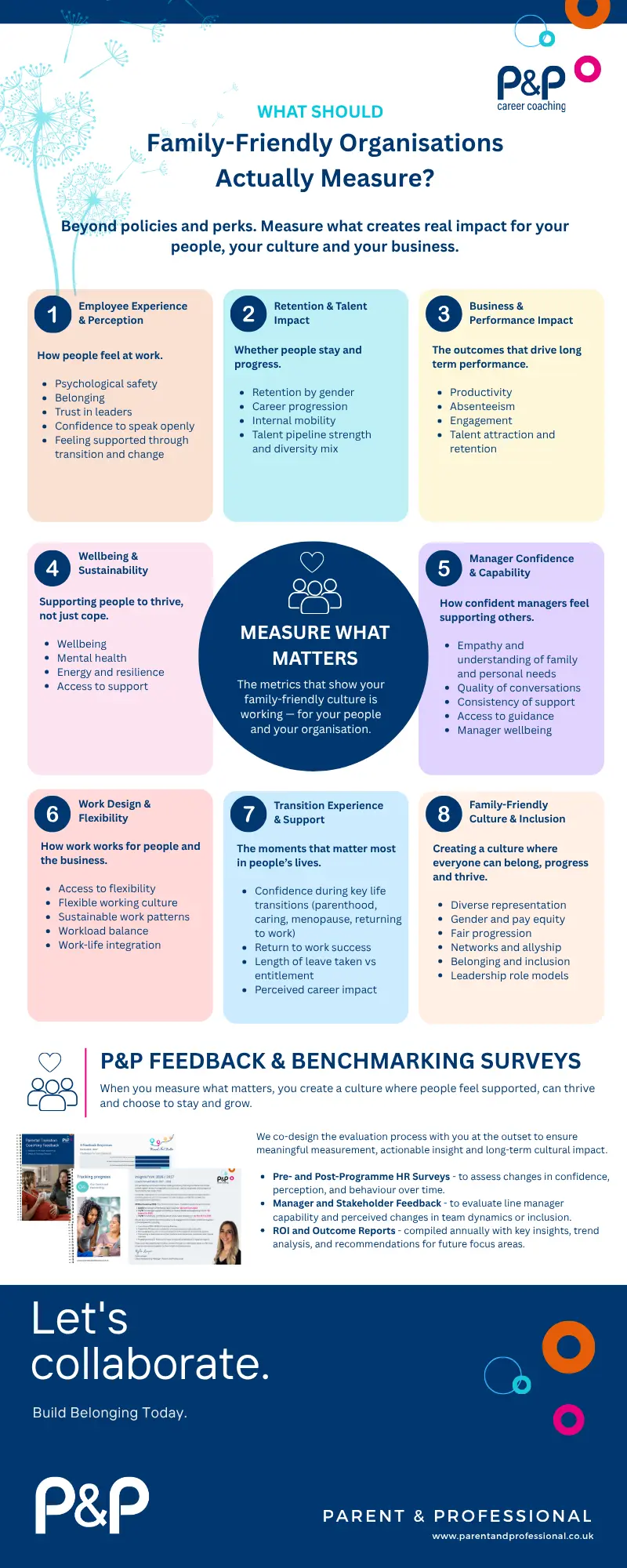
What Should Family-Friendly Organisations Actually Measure?
We’ve recently created a infographic to help People Leaders, DE&I Specialists and L&D Managers in understanding – What Should Family-Friendly Organisations Actually Measure? (see graphic below.)
The infographic provides a practical overview of the key areas organisations should consider when evaluating the impact of family-friendly culture initiatives, including:
- Employee experience and perception
- Retention and talent impact
- Business and performance outcomes
- Wellbeing and sustainability
- Manager confidence and capability
- Work design and flexibility
- Transition experience and support
- Family-friendly culture and inclusion
It also highlights the importance of measuring both organisational outcomes and employee experience together, because policies alone rarely tell the full story.
At Parent & Professional, we’ve recently refreshed our feedback and benchmarking survey tools to help organisations better understand the real impact of their family-friendly culture initiatives.
Our approach includes:
- Pre and post-programme HR surveys
- Manager and stakeholder feedback
- ROI and outcome reporting
- Longer-term culture and confidence measurement
Ultimately, measuring what matters is not about creating perfect scores or ticking boxes.
It is about listening carefully to employee experience and creating workplaces where people feel supported, can thrive and choose to stay and grow.
Download the infographic summary: