
Inclusive Leaders Value Uniqueness, Connect Difference and Create Belonging

What actions can inclusive leaders take to accelerate belonging? Dawn Jackson, EDI Consultant and Inclusion Coach at Coach Inclusion, shares practical insights through her exploration of her Inclusion and Belonging Model.
The power of inclusive leadership lies in an ability to build meaningful team bonds creating a feeling of belonging in others as they feel able to contribute and share their views openly. People who feel belonging, feel psychologically safe to be their best selves and trusted, able to make mistakes, take risks and speak up without fear of consequence.
The Inclusion and Belonging Model
The Inclusion and Belonging Model below helps a leader understand how to create belonging by not only valuing a person’s uniqueness but crucially by actively fostering connection and collaboration. By understanding what makes each person unique we make them feel their difference is acknowledged. Connecting difference goes a step further and creates the feeling of belonging because individuals understand how they each add unique value to the team they work within.
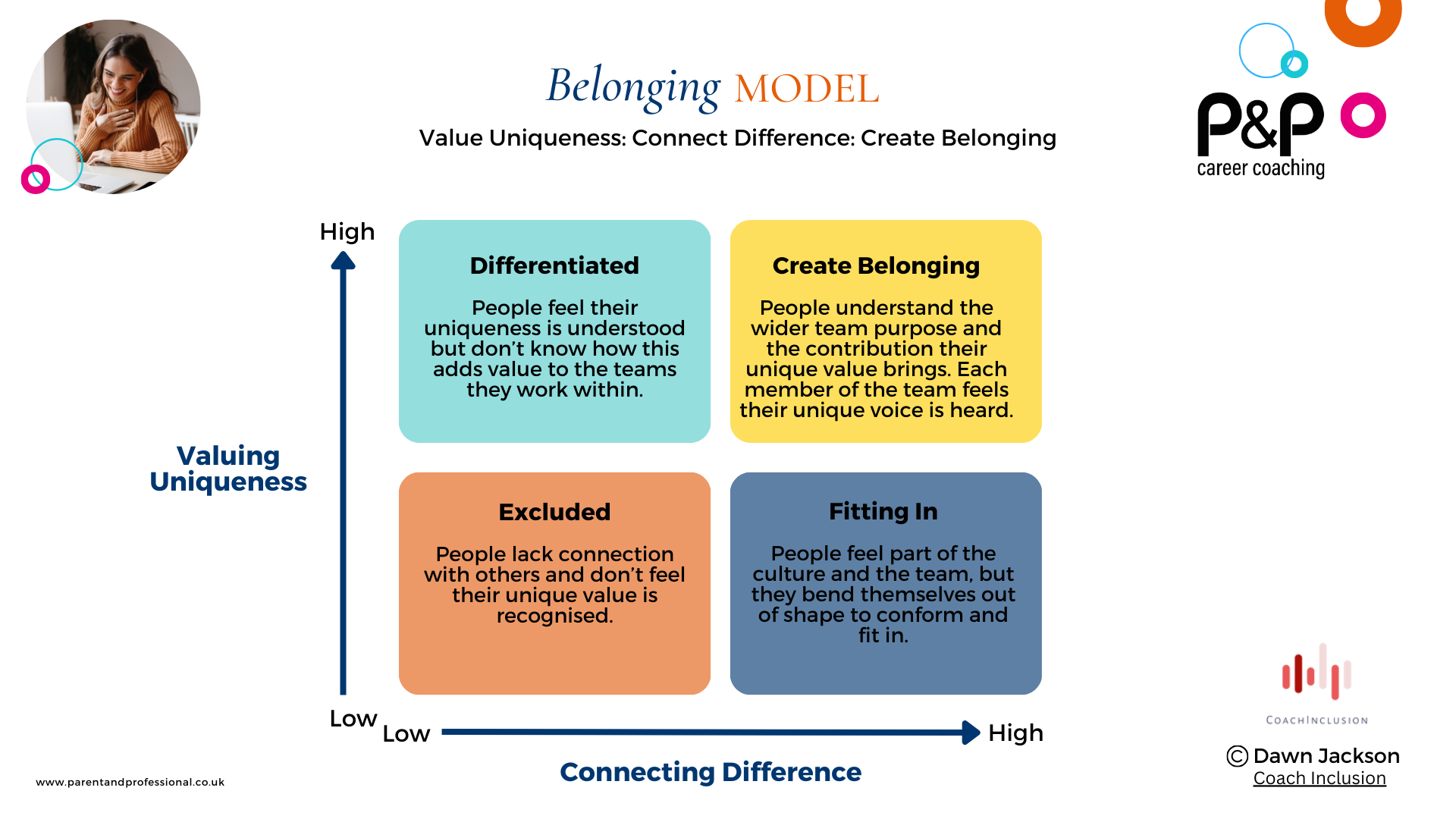
The leader who unlocks the diversity in their team by actively fostering connection across difference will see in return, higher engagement, greater collaboration, and innovation. Practicing inclusion every day in the conversations we have as leaders builds diverse teams that make better decisions and create workplaces where people will want to stay.
We often hear the terms inclusion and belonging used interchangeably, but inclusion is a choice which generates a feeling of belonging in others in the same way we might for example choose to create a feeling of trust.
It is important to note that creating belonging through active inclusion is important at all leadership levels. Senior leaders practice inclusion at the top of the organisation by communicating the organisation mission and values in a way that resonates personally with everyone. Inclusive team leaders not only create the ‘golden thread’ linking this mission to a clear and compelling team purpose but ensures that every team member feels personally invested in it. This creates a sense of shared community and camaraderie where people feel they are “in this together “.
So, what actions can inclusive leaders take to accelerate belonging?
Inclusive leadership starts with a leader who is both willing and committed to developing self-awareness, courageously exploring what makes themselves unique whilst having the courage to be open and show up as their authentic selves. This openness and honesty brokers trust between team members and the leader.
Understanding what makes us as leaders unique helps us be better role models and active allies not only to our teams but to others we work with. Inclusion allies recognise the unique value of everyone around them. They leverage their own power and influence to proactively support, advocate for and champion uniqueness at the same time empowering their team to be allies for each other.
Leaders as role models lead by example, demonstrating inclusive behaviour and collaborative practices with their teams and their peers. They know their people well and model inclusion through their language and behaviour consistently using the right tone and appropriate language in their everyday conversations.
Leaders create belonging by being able to create and communicate a clear and compelling team purpose, a ‘compass’ which guides the team to action and motivates every member to work towards a shared goal. Providing this clarity whilst avoiding ambiguity enables each person in the team to identify where their role fits. Inclusive leaders focus on ‘culture add’ when building diverse teams, not only cultural fit. This means understanding what unique attributes complement the team moving forward rather than recreating the same homogeneous teams that may well already exist.
Encouraging teamwork, collaboration, and equal participation among team members make for effective teams. Leaders who practice inclusion create and encourage’ leaning in’ to difference, seeking opportunities for connection and encouraging collaborative problem-solving teams as well as cross functional teamwork. They foster belonging by involving employees in decision-making and encouraging diverse perspectives, gathering input from team members before making important decisions. They acknowledge and reward collaborative efforts and contribution and celebrate team successes and collective achievements.
Conflict is an inevitable and important part of teamwork particularly in diverse teams where perspectives may differ, but it does not have to be unhealthy or counterproductive.
When managed well, conflict can be positive and unlocks diverse thinking. Also, when team roles and responsibilities are well defined, and expectations are clearly established, teams perform better as potential for conflict is reduced.
Conflict occurs when people feel threatened, and which impacts belonging. When people sense others in the team have more priority and attention this creates a threat response and undermines the feeling that they matter. Inclusive leaders mitigate the threat response by making a conscious effort in every interaction to ensure that no one is valued more than another and that everyone’s contributions are acknowledged irrespective of their difference.
Leaders can also address avoidance of conflict in teams by routinely creating project opportunities which proactively bring difference together and where finding common ground is necessary. This transforms teams into safe spaces where healthy, non-judgmental conflict is normalised.
Giving and receiving feedback is another area where team members may feel unsafe and particularly fearful of upsetting colleagues who may be different. Inclusive leaders actively encourage and demonstrate the value of constructive feedback.
Getting to know your team members and knowing what questions to ask as leaders will help promote that feeling of psychological safety and belonging. We as leaders often feel we need to know the answers to questions, rather than know how to ask the right questions! Being ok with appearing vulnerable will lead to leaders asking courageous questions and then listening to understand rather than respond!
Examples of Inclusive Leadership
Examples might include asking:
‘What one thing can I do as a leader differently to help you succeed?’ or simply: ‘what motivates and inspires you?”
The role of inclusive leadership in creating belonging is powerfully compelling. Valuing uniqueness and connecting difference are practical steps leaders should consider when creating belonging and unleashing the real hidden value of diverse teams.
Author: Dawn Jackson, Coach Inclusion